Futh enters Ester’s private apartment
The Lighthouse (Alison Moore Edition)Futh enters Ester’s private apartment while searching for the silver lighthouse he has discovered missing from his suitcase. What begins as an attempt to ask Ester about the object turns into an unauthorized search of her bedroom: he finds the lighthouse among her perfume bottles, takes it, and retreats to the bathroom when someone returns. The episode makes the missing object a concrete link between his present uncertainty and memories of his mother, while ending at the threshold of discovery, before the consequences of his intrusion are shown.
The Missing Lighthouse and the Search
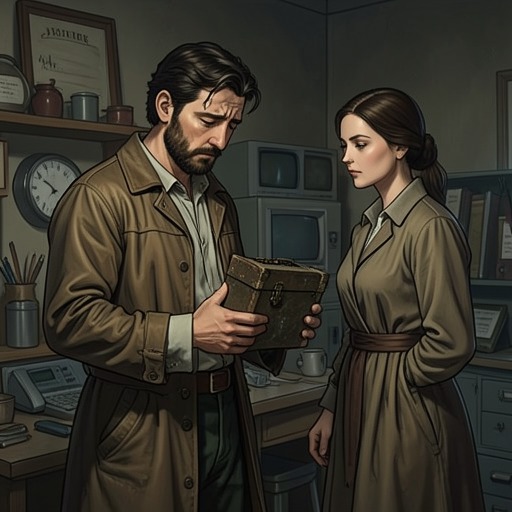
The search begins after Futh has bathed and realizes that the lighthouse is not in his suitcase. He checks again, finds it absent, and sees that the hour is late. Rather than get dressed, he leaves his room in his pyjamas and goes down to the bar, hoping to locate Ester and ask about it. Her stool is empty. Futh asks the woman behind the bar where Ester is, but although the question and answer are in German, he cannot understand the reply. The woman turns back to her customer before he can ask her to repeat it. He notices the barman who had refused him breakfast earlier in the week but decides against approaching him, both because he expects no help and because he is still in his pyjamas.
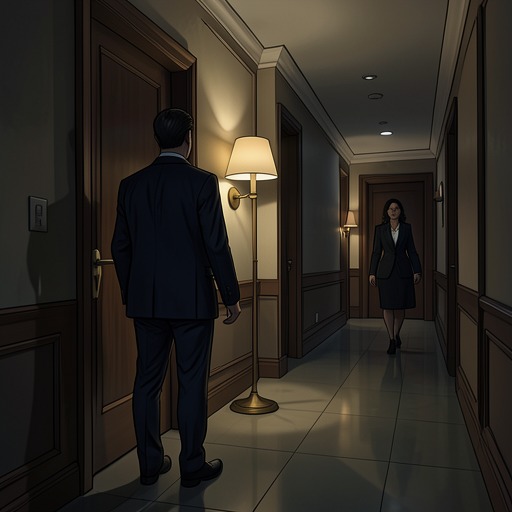
Back upstairs, Futh hesitates in the corridor before going to a door marked for private use. It is a fire door; he pushes it open and finds another stretch of corridor leading to an apartment. His pursuit has therefore moved beyond the ordinary public areas of the hotel and into space explicitly set apart from them. He listens at the apartment door, hears what seems to be a woman speaking, knocks, and gets no answer. The door is unlocked. He enters, calls Ester’s name, hears laughter, and calls again from the doorway before stepping inside. The door closes quietly behind him.
Inside Ester’s Apartment
Futh moves down the hallway, calling for Ester, but finds no one in the small living room or the even smaller kitchen. The voice that drew him in is coming from the street below through an open window in the end room. The apparent sign of someone’s presence has led him into the apartment without actually locating Ester; for the moment, the rooms appear empty.
Near the window is a bed. Futh sits on it to rest his aching legs and considers what to do about the missing lighthouse. He thinks he might wait until morning and ask at breakfast, but doubts that the barman would be helpful if Ester were absent again. The apartment’s ordinary personal details come into view while he delays: a well-used romance novel lies on the nightstand, and he picks up a bottle of lotion and tries some on his sunburn. These details place him not merely in a corridor where he might have mistaken his way, but in a private room whose belongings belong to Ester.
He then notices an open door to an en suite bathroom and, near it, a wardrobe and dressing table. A silver lighthouse is on the dressing table. As Futh rises and crosses the room toward it, he hears someone entering the apartment. He recognizes that the explanation available for having crossed the fire door will not explain his presence in Ester’s bedroom. He slips into the bathroom and pushes the door nearly closed. The search has found its object, but finding it has made his position more precarious: he is now concealed inside the private apartment, close to the lighthouse and dependent on not being discovered.
The Object in the Drawers
From the bathroom, Futh watches Ester enter the room through a narrow gap. She carries a covered plate of cold meat, boiled eggs, and salad, sets it on the dressing table, and puts the silver lighthouse into a drawer. She then takes cigarettes and a red lighter from another drawer and smokes at the open window. After she leaves with the plate, Futh waits, supposing that she may be bringing the meal to his room and will return shortly. He comes out of the bathroom and searches the dressing-table drawers.
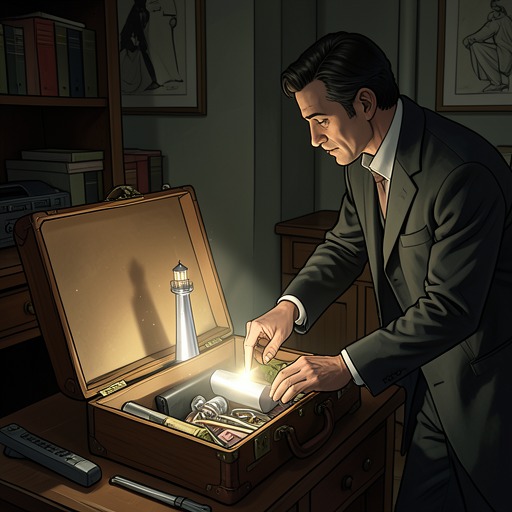
The first drawer holds makeup, jewellery, and small jewellery boxes. In one box, he mistakes a pinned insect for a brooch before recognizing it as a moth; he touches its still wings and closes the drawer. The second contains underwear, including the pink satin pair he had found beneath his bed the previous week. In the third are many perfume bottles, ranging from inexpensive to expensive, alongside novelty containers, among them a blue glass skyscraper and a small wooden lighthouse. Beside these stands what Futh takes to be his own silver lighthouse. He removes it when the apartment’s front door slams, then retreats to the bathroom again.
The episode does not explain how the lighthouse came to be among Ester’s possessions, but its placement there changes the search from uncertainty into a discovery: the object Futh was looking for is in her private room, in a drawer with her perfumes. He has it in his hand while hiding, yet he is only vaguely aware that it feels unusually heavy. The object is both the reason he crossed the boundary and the thing that makes it harder for him to leave without being noticed. His immediate worries turn to being ordered out of the hotel, having to sleep in his car without a blanket, and missing breakfast again.
Memory, Scent, and the Unfinished Encounter
While Futh is concealed, the present room repeatedly opens onto earlier memories. The camphor smell from a bottle by Ester’s bath recalls the interior of his mother’s wardrobe, a space where he used to sit among her clothes. In his memory, the wardrobe’s leather, cigarette smoke, and camphor belong to a private idea of his mother that he once wished he could preserve as an essence. That recollection gives the current room a second meaning: the search for a small scented object is also entangled with the remembered closeness and eventual loss associated with his mother.
Other earlier scents and objects establish the continuity without making the two women interchangeable. When his mother first handled the lighthouse, she put its perfume on her wrists and throat, and the car filled with the smell of violets. Years later, on the train from Cornwall, the broken vial remained in Futh’s pocket; his hands and boots smelled of violets, while his mother smelled of orange. As an adult working in the manufacture of artificial odours, he would associate octyl acetate with sadness. In Ester’s apartment, camphor again pulls memory into the present, while the cigarette smoke and perfume bottles place that recollection within a room belonging to someone else.
Futh remains hidden as Ester returns. He hears her heels on the floor, then hears her pause, approach the bed, and move back toward the wardrobe. Her fingernails drum against it as though she is thinking. The account stays with Futh’s attempt to remain quiet and his fear that she will come closer; it does not disclose what Ester intends or what she has noticed. She reaches the bathroom door, and camphor is the last scent registered before the light comes on. The scene stops at that instant of exposure, leaving the outcome of Futh’s intrusion unresolved in the evidence of the episode.